My year-long rant vacation continues! But since I traditionally take June off from ranting to rest up after the busy season at my job, I figured, why not fully invert things and take some of June off from resting up to throw a rant up here? So here we are, the mid-year break from taking a break, typed up and ready to go!
Of course, you might expect that, after such an absence and before resuming that same hiatus, I might at the very least leave you with something insightful and profound. But you probably wouldn't, because I make this joke every time I do something like this, so yeah, today's just a stupid rant where I indulge my dumb sense of humor. Except that it's somehow even worse than that, because it's also an adaptation of a conversation I once had in the comments section of 1 of my rants--and no, I don’t possess enough shame to apologize for that. Enjoy the reminder that maybe we're all better off when I don't upload!
It’s funny the kind of stuff you’ll just nod your head and accept when a game’s good enough. I’ve spoken about the weight of quality allowing for a greater weight of disbelief to be suspended and balanced against it, and I definitely think that the Doma incident of Final Fantasy 6 is a good example of this, because...there is no way anyone would buy the poisoning of Doma if Final Fantasy 6 were a lesser RPG. Had we been any less engrossed in and entertained by the story of Final Fantasy 6 as it progressed, this moment would probably have been immortalized as an example of when a writer has to overreach and make a story event happen no matter what. Because Doma’s poisoning doesn’t make any damn sense when you scrutinize it on any level.
Alright, so let’s just go over the events here. Sabin sneaks into the Empire’s camp from which it’s launching its invasion of Doma. He opens some treasure chests, beats up some guard dogs maybe, and winds up eavesdropping as Kefka reveals he’s gonna poison everyone in Doma to wrap up this whole invasion in a jiffy. Sabin steps in, attacks Kefka, chases him around, tries to stop him, but gets caught up in fighting guards while Kefka slips away. Kefka goes up to the nearby river, by himself, and puts his poison into it. We then cut to Doma Castle, where a lookout remarks to Cyan that the Imperial camp is full of activity--presumably the havoc that Sabin is causing--after which Cyan notices that the water looks odd (a nice touch is that the color of the water at the beginning of this scene, seen at the corner of the screen, is different from the color of the water by this point; the water becomes more discolored as the scene plays out). Doma guards suddenly start dropping dead left and right, Cyan and the lookout realize poison’s at work, Cyan races through the castle and finds that the king and pretty much everyone else is dead, including his own wife and son. Infuriated, he runs out to the Imperial camp to start killing everyone he can.
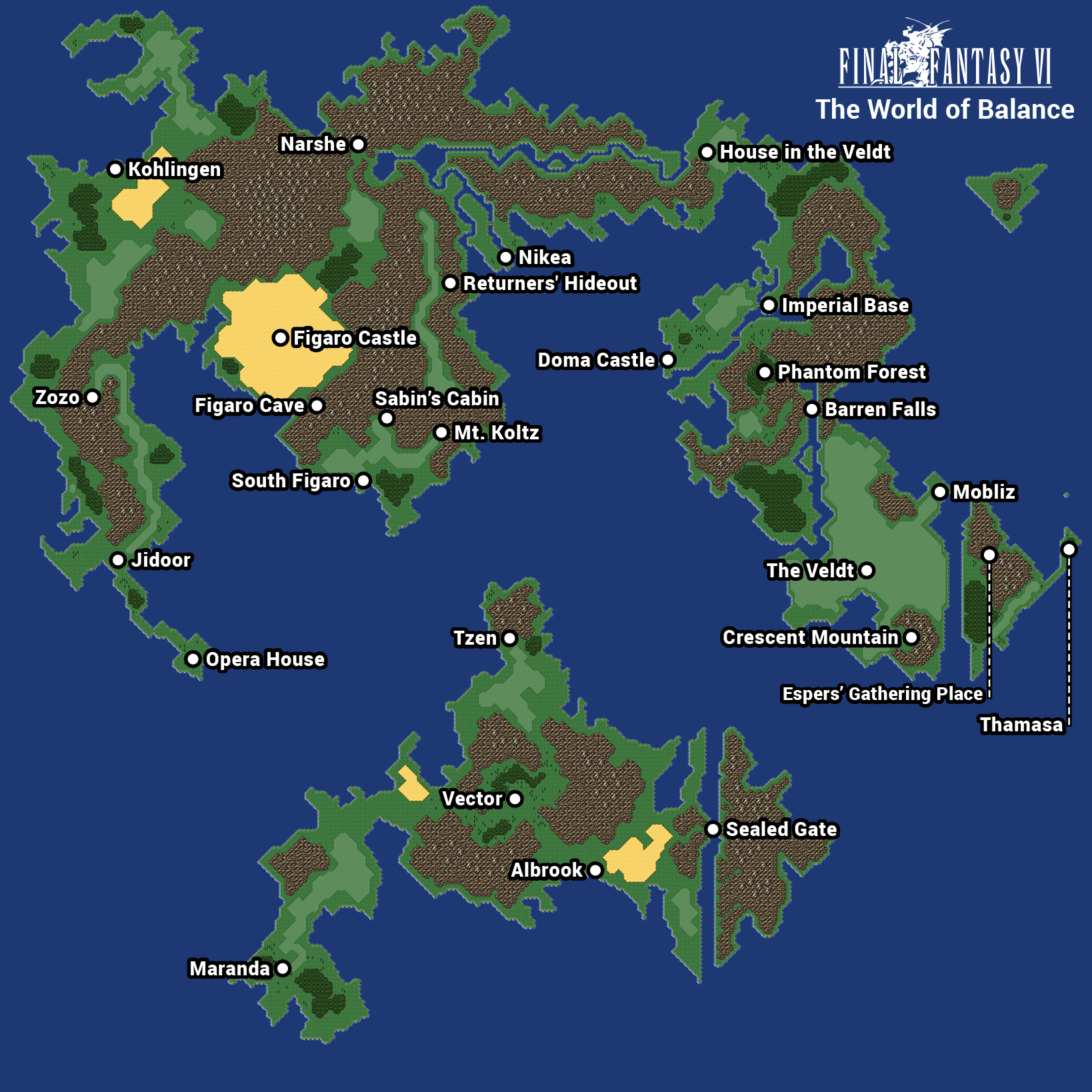
So yes, it’s a great and memorable scene in RPG history. Very diabolical. Very unsettling. Very tragic! Very moving! Very...uh...very........um, say, how far away from Doma was the Imperial camp, again?
Uh huh, uh huh...okay...yeah...mmmhm...so...relative to our own planet, about the distance from Switzerland to Portugal.
Man, that one lookout guy has got really good eyesight.
I’m sorry, you’re telling me that the poison that Kefka dumped into the river was able to travel along a body of water that looks to be equivalent in length to the Red Fucking Sea over to Doma inside, what, 10 minutes? 20? An hour, tops? Remember, the scene in which Doma’s citizens succumb to the poison opens with the lookout noticing the extra activity in the Imperial camp, and the implication of that is that Sabin is still currently causing a ruckus over there, so the maximum amount of time between Kefka dumping the poison and its taking effect is however long we can realistically assume Sabin can keep fighting off an entire camp of enemies without getting killed or captured--he is, after all, fully free and able to come assist Cyan later, when Cyan arrives at the camp to take his vengeance. So unless you think Sabin A: can, at this time, successfully combat presumably dozens or hundreds of armed opponents for hours without a break and essentially solo an entire military invasion army, or B: retreated at some point (leaving the camp still noticeably active) and decided to just chill and let this whole poison thing work itself out without his further intervention, neither of which seem terrifically likely, then we have to accept a timeline in which the river has managed to bring Kefka’s poison from the camp all the way to Doma within, at the absolute most generous estimation, an hour.
Honestly, for anyone getting a drink from the Doma river that day, poison should have been the least of their concerns. The speed those waters were going would’ve left anyone who bent down for a sip missing the bottom half of their skull!
But okay, let’s back up a bit. We can’t really say that we know how far away the Imperial camp was from Doma, because we don’t know the size of FF6’s world relative to our own. Maybe FF6’s entire globe is only as big as, say, our own world’s state of Texas. Maybe Cyan’s ability to run all the way from the castle to the enemy camp before Sabin’s rampage has ended isn’t evidence of the popular fan theory that he was secretly Sonic the Hedgehog all along. We don’t know the metrics of FF6’s world, and it’s not likely that the random Doma lookout NPC had telescopes implanted into his eye sockets at birth, so logically we should at least allow for the possibility that the actual distance that the river covered between these 2 points was not terribly far.
Maybe not so short a distance that this scenario’s time frame could still make sense, but, uh, it’s not too far-fetched, right?
Certainly not as unbelievable as the striking efficacy of Kefka’s poison, that’s for sure. Holy crap, just how potent is this stuff? The guy drops 1 dose of the stuff into the river by his own camp (sure hope no one on HIS side was planning to have a drink between now and the end of their tour of duty), and that’s enough to pollute the water supply of the entire castle so thoroughly that almost the entire population succumbs to it!
I mean just think of the logistics for a moment here. We don’t see a barrel sitting next to Kefka during the scene of releasing the poison, nor any other large object that could be a container. Whatever amount of poison he has, it can’t be more than what he can realistically carry on his person--and even then, there has to at least be enough free space on him that he can take a couple hits from Sabin in their preceding fights without the impacts dislodging, freeing, or otherwise causing a loss of the poison. There’s an implication that the poison is in a quantity and container accessible enough that it was handed off to him by a subordinate, even. So it’s basically, at the maximum, as much poison as 1 guy could carry, being spread through an entire river, and somehow there’s still enough of its presence uniformly in the water after its journey to be fatally ingested by not just a few, but dozens of people.
Holy shit, Kefka, what kind of insane fatality-to-ppm rating does that toxin have? This stuff makes botulinum toxin look like ketchup by comparison! That poison’s knocking people dead after being more diluted than the fruit flavor in a can of La Croix! Forget being so prevalent that the entire body of water turns purple from it--given the volume of water surrounding and running through parts of Doma Castle alone, the Imperial camp could be just down the street from Doma and it’d still be a miracle for there to be enough poison molecules to go around for everyone in the castle to manage to get some in their next cup!
Actually, the real miracle is how everyone in the castle even managed to drink this poisoned water to begin with. I mean, the water only starts turning purple moments before the residents of Doma begin keeling over from it. Like, the river’s normal-colored at the beginning of the scene, Cyan and Lookout Lad exchange something like 5 sentences, and by that point the water is noticeably discolored and the bodies start hitting the floor. If we’re supposed to take the water turning purple as an indication of the poison’s arrival, that means that the first guy that we see die would barely have had the time to get a sip of the water if he’d been STANDING in the stuff. And he most certainly wasn’t; he was up on the ramparts, in fact! The implication here is that somehow this guy had the ability, as Cyan and Lookie-Loo exchanged a total of 4 text boxes, to dash a glass through the water, take a gulp, and then run up to the second floor and across the length of the castle in order to get in place for his collapse, IF we’re generous enough to assume that he started down where the water was.
Meanwhile, the king’s sitting in the middle of the castle, fully isolated from the river, yet somehow has also managed to get ahold of the magical purplewater in time to have collapsed before Cyan shows up--and we have to assume that he was drinking at about the same time as everyone else nearby, because otherwise His Majesty was watching his court fall to their knees gurgling in agony all around him after taking a sip break, and thinking to himself “Ooh, Imma have what they’re having.” Doma’s royalty had to have some of the most ferociously dedicated and fleet-footed water-boys ever conceived for one to have fetched a drink from the river as Cyan notices it discoloring and gotten it to the king before any kind of the commotion of people dropping dead in droves could catch up to him. There’s so little room for error that the royal water courier must’ve just plunged his head into the river, filled his cheeks up with water, made a mad dash for the throne room, and the moment King Doma opened his mouth to ask what the fuck was up, spat the entire volume of it into his face.
Why’s the king drinking the same dirty river water as everyone else, by the way? What, there’s like, not a single cask of wine or mead or such left in the entire castle? You’d think that if the castle was already that low on supplies, Cyan wouldn’t have been so hot for the “lock the doors, board up the windows, and let the walls do their job” strategy that he suggested last time we saw him and that I employ every time I hear my doorbell go off.
But hey, let’s say, for the sake of argument, that we’re not beholden to the actual water coloration timeline. We’ll say it’s a narrative flourish, not literal, and the poison’s already present in the water as soon as Kefka pours it in, rather than just once we’re visually alerted. It STILL doesn’t make any damn sense. We’re still stuck to the timeframe of Sabin’s fight actively occurring in the camp, so that means that, at some point in the past hour, every single person in Doma besides Cyan and Sir Looksalot got thirsty. I know hydration’s important, but you’re telling me that only 2 people in the entire castle were too busy to grab a drink in the past hour?
And keep in mind, everyone’s dying at about the same time, with only intervals of seconds between them. So not only was EVERYONE in Doma both thirsty and picky like that kid in Signs who doesn’t want to drink water that’s been in a cup for more than 30 seconds, they all just happened to drink the water simultaneously. From the guards to the civilians to the king, everyone must have had a water break at functionally the same time. There was, over the course of that morning, a point at which the safety of the entire kingdom was held in the hands of exactly 2 individuals, as every other soldier in the entire military went on a synchronized water break. What, did the king just happen to host a ritualized, communal Koolade meeting every morning--one that Cyan and Looksmaxxor93 weren’t invited to--and through some tragic cosmic irony this drinking tradition happened to end the same way as the last time someone did it?
No matter how you look at it, the Doma poisoning event is ridiculous. Whether it’s the river needing to flow with a power and speed that would make most water jet cutters envious in order to deliver the poison in time, the poison somehow being so incomprehensibly effective that the amount a single person can carry will so lethally pervade an entire geographical body of water that dozens of people can all take a sip and be guaranteed to have ingested a lethal dose, or the fact that an entire settlement’s worth of people minus 2 managed, regardless of location, responsibility, or circumstance, to all happen to take a drink of water within the same 60-second window of the same hour of the day, the logistics and requirements for it are ludicrously impossible.
And because that’s amusing to poke fun at, I’ve written this rant. But I do have to say, it also kind of makes this scene a testament to just how good Final Fantasy 6 really is--in a game that wasn’t so compelling and engrossing, we’d be removed enough from its events as an audience to recognize the absurdities of this situation and chuckle at the stretch it’s making. But in FF6, we’re caught up in the flow of its storytelling enough that we don’t have enough distance to question the logistics of Doma’s poisoning; all we experience is the tragedy of Cyan’s loss and the outrage of Kefka’s evil, and all we remember is a poignant milestone in a great plot.
Wednesday, June 18, 2025
Final Fantasy 6's Poisoning of Doma


Saturday, February 8, 2025
General RPG Valentines 7
As I said last time, I'm going to be largely taking 2025 off from ranting, to hopefully come back to it fresh next year...but as I also said last time, I'll be damned if I miss the chance to inflict a bunch of stupid RPG Valentines on all of you, vacation year or no. Because I believe in love, dammit! And also (far more), I believe in amusing myself.
And seeing as I'm depriving (read: relieving) you all of the delight (read: burden) of experiencing my usual rant-load (read: a very different, distinct other kind of load) this year, I think the least I can do (no, really, there is literally nothing less I could do for you than this) is to give you a bonus 5! So here you are, a heaping extra portion of 25 RPG Valentines for 2025 Valentine's Day!


And of course, if I'm gonna give you an extra 5 RPG Valentines this year, it's only right that I also gift a bonus 5 RPG Anti-Valentines, too! And yes, that may mean that you're getting only 25% more positivity compared to an increase of 100% negativity, but insert witty reason to explain this situation here!


Wednesday, January 8, 2025
General RPG Lists: Greatest RPGs
Hi, all! Before you partake of the fifth, yes that's right this list has been rereleased almost as many times as Skyrim now, version of this rant, let's all huddle up real quick for a little announcement:
I...will be taking 2025 off.
Well, I mean, not ENTIRELY, I guess. Obviously there's this rant, and I'll be damned if I let an opportunity to showcase more stupid RPG Valentines pass me by, and there'll be an Annual Summary rant for sure. I might also throw a few others up here and there over the course of this year. But by and large, I'm gonna take a break from ranting in 2025.
And the reason for that is probably about what you'd think. After doing this regularly for close to 20 years now, I'm understandably a bit burnt out. I still like sharing my thoughts with all the Audience Not Founds out there, but coming up with those thoughts is getting harder and harder. You may have noticed that in the past couple years, only a comparative handful of the rants I've written have been based on RPGs in general or a game that I hadn't played in the last 3 years. And that was still functional when I had both Shin Megami Tensei 5 and SMT Persona 5 to yap about, as I got a lot of rant mileage out of each of them, but I can't really depend on there to be a game I play each year that happens to stimulate a solid 10-ish rants out of me. I mean, okay, granted, I'm probably gonna get a good few out of how obscenely awful Tokyo Mirage Sessions #FE is, but still. With my having said most of what I've got to say about the games I've played in the past, I'm fresh out of rant reserves and need some serious time to build up a few as a cushion once more.
I'm also just older, busier, and less able to focus on tasks than I used to be, and writing is thus something I have less time and effort to put into in general. Frankly, I'm just not gonna be able to keep up my 3-a-month standard at the pace at which I write now.
So anyways...I'm gonna be largely absent for 2025. The hope is that I'll be building up a nice, robust reserve of rants to keep me afloat when I come back in 2026. I'm sorry to anyone who might genuinely be disappointed by this, but this is and always has been a hobby, and for me to keep this hobby going any further in any meaningful way, I'm gonna need a good, proper break from it to rev myself back up again. I hope you'll at least be able to enjoy the new content being added to today's List, and the bits and pieces that do go up this year. Thanks for reading, both this and in general.
Now, onto the actual damn rant already!
This was a list of 10. Then 15. Later 20. And then 7 years ago, it was made a list of 25. But the fact is, I'm still playing RPGs, and I'm getting more and more selective about the games I play (in spite of what you might think of the man who voluntarily experienced Tokyo Mirage Sessions #FE from start to finish last year), which means more and more truly, spectacularly magnificent titles that I'm adding to my resume all the time. With a current count of 439 RPGs under my belt, over 100 more than I'd played at time of this rant's last update, even a list of 25 of the greatest seems insufficient now, and a normal jump of just 5 more would only be restoring titles to this list that had been pushed off by newcomers like Disco Elysium and Pyre. So today, we're expanding the list of the Greatest RPGs of all time to a whopping 35 places!
And even then, this list STILL, in accordance to the laws I set down for myself in its last iteration, reflects significantly less than 10% of all the games I've played from this genre. In spite of being so long, this collection still very much represents the absolute cream of the crop.
So, logically, that means that even if you don’t see your favorite game here, I hope you won't yell at me. Believe me, I know that there’s an absolute TON of great RPGs that didn’t make the cut. You genuinely have no idea how much I hate that I couldn’t get Valkyrie Profile: Covenant of the Plume, Shadowrun: Dragonfall, A Dragon's ReQuest, Horizon: 0 Dawn, and several other games onto this list. How frustrated I was when I finally admitted to myself that, realistically, there's just never going to be a time when Fallout 1, which is 1 of my absolute favorite RPGs of all time and in no small part defined me as a person, makes it on here. But it just wasn’t in the cards, no matter how great such titles are. Believe me, I wouldn’t begrudge anyone a spot on their Top 10 or whatever list for, say, Deus Ex 1, or Baldur's Gate 3--it’s just that with all the amazing RPGs I’ve played, even such laudable, excellent works as those can’t quite cut it.
Anyway, I think that's enough yapping and delay. Without further ado, the 35 greatest RPGs ever created!
35. Shin Megami Tensei: Persona Q1 (Nintendo 3DS)
This is an odd one, particularly to start this list with, because by all rights, SMT Persona Q1 should be way higher on this list, and also, not here at all. Basically, for something like 3/4ths of the game, Persona Q1 is just a fun, simplistic piece of fanservice-y fluff with the casts of both Persona 3 and 4 bouncing off of each other, interacting with themselves in ways they normally couldn’t (Theo and Elizabeth’s dynamic is damn hilarious), and playing off a couple of likable but largely unremarkable original characters, as they progress through an improved version of an Etrian Odyssey system of dungeons whose connections to one another and to the OC couple are vague and handwave-y enough not to pay too much attention to. It’s pleasant, but nothing particularly intriguing.
BUT, once you hit the major plot twist revelation at that 75-ish% mark...Persona Q1 becomes an emotionally overwhelming, heartbreaking, impassioned examination of existential fears and the question of what makes a life worth having lived, posing a question so heavy and postulating answers so profound that the experience still lives with me, and likely always will, in ways more significant than even most games on this very list can boast. I was moved to tears by the tragedy of the truth of Persona Q1, and it wasn’t the last time the game would make me weep--1 of my most fond and embarrassing memories as a gamer will always be that I finished playing this game during a long wait at a car dealership as my vehicle was having some work done. I was sitting there, in the waiting room--in a corner faced away from the rest of the room, admittedly and thankfully--as tears streamed down my face while the ending played out and taught me a poignant lesson about the human condition. Seriously. Just...imagine walking into a dealership, all set and ready to lease a brand new Toyondalet 20Teen Speedster Supreme Plus Deluxe, and the first thing you see as you happen to glance to your left is some dumpy 30-something-year-old sitting in the corner while his airbags are replaced, lacrimating uncontrollably as he snuffles and snorts ugly-cry snot back up his nostrils while staring down at the screen of the same game system on which your little brother plays Mario Kart. It's wildly amusing to me, in retrospect.
But anyway, that all makes Shin Megami Tensei: Persona Q1 a title that’s baffling to place here. Going strictly by the quality of its best quarter, and how well it makes meaning and sense of what led up to that moment, SMTPQ1 should probably be much further into this list, up there with absolute RPG titans like Omori and Final Fantasy 7 (and as a side note, what an amazing thing it says about the SMT series and its Persona subseries that this would still not make Persona Q1 the best the series has to offer?). But then again, no matter how excellent its last quarter, a game that’s 3/4ths enjoyable but largely immaterial fluff probably shouldn’t be here at all!
Well, the Honorable Mentions are all tied up with specialty cases like DLCs and fan mods and whatnot, so I can’t take the coward’s way out and just throw this game down there. So I guess the best I can do is give Persona Q1 a permanent spot on this list as an opener, because it’s just too extraordinarily wonderful not to be here, and yet too cluttered with filler to be above any other, inarguably deserving title.
34. Final Fantasy 10 (Playstation 2)
FF10 has its share of detractors, but it’s overall quite well-loved, and for damned good reason. This treasure of the genre boasts an emotionally powerful and intelligent story packed with themes and perspectives on religion, sacrifice, love, and purpose, several excellently dynamic characters, and some of the most moving scenes in any RPG. Both overtly and subtly, Final Fantasy 10 is enjoyable, touching, and deeply meaningful.
33. Children of Zodiarcs (Personal Computer)
Children of Zodiarcs is a hell of a heavy ride, and it’s not shy about punching you in the heart, again and again, as it tells its story of extreme class divides, the nature and toxicity of hatred, and the manner in which the pains we inflict upon the rest of the world perpetuate themselves unto innocents, again and again, until finally they come back to destroy us, as well. There’s a lot of wisdom and inspiration to take from Children of Zodiarcs, if you can weather the frank brutality of the world that it showcases and endure the heartbreak it will inflict upon you over the course of its harshly hopeful narrative.
32. Shadow Hearts 2 (PS2)
Ah, Shadow Hearts 2. The uniquely moody, gloomy, yet over-the-top and amusing atmosphere created with Shadow Hearts 1, which perfectly mixes the reality of Europe and Asia in the first half of the 20th century with mysticism, really hits its stride in this sequel, just in time to accompany an interesting plot whose arcs are surprisingly well-connected, given how clearly each part is defined by its setting and villains. Toss in a truly excellent and unique hero, a solid and diverse cast, a love story that’ll have you bawling like a babe, and some moments that are just plain awesome (a battle between a hell demon and Rasputin aboard a flying battleship? Hell YES), and an all-encompassing sense of quirky humor that works surprisingly well with the dark, serious tone of the game, and you have a real winner.
31. Mother 3 (Game Boy Advance)
The sequel to RPG cult favorite Earthbound (Mother 2) was heavily yearned for and anticipated for many years before Nintendo finally bit the bullet and made it. I think everyone hoped that a sequel would do the original game proud, perhaps even be as good as it, but I doubt many people would have ever imagined Mother 3 could surpass its predecessor. Yet it has, and by a lot. Earthbound was a singularly bizarre adventure, defying description with its quirky humor and presentation--it was like playing a piece of abstract art. Mother 3 manages a complete return of this same unusual and appealing style, but manages to throw a huge curveball on it with a huge injection of emotion into a plot that is jaw-dropping in how poignant it is in spite of (perhaps even because of?) all the quirky humor sown into it. And when you look past the creative nature of the game, you find an equally creative plot, too. Mother 3 will make you laugh aloud, it’ll make you think, and it’ll make you sniffle and get teary-eyed. And it’ll do all of these things in the same 5 minutes.
30. Grandia 1 (Playstation 1)
I don’t know what to say, really. I love Grandia 1. The characters are good, the plot is solid, and this game, above every other RPG I’ve ever played, creates a sensation of exploration and adventure, through its great music, strong attention to cultural and natural diversity in its setting, and the enthusiasm of its protagonist. It has a lot of truly excellent moments, such as Sue’s goodbye, and reaching the top of the End of the World, and many of its small aspects are great, too, like the dinner conversations (which became a delightful signature of the series), and one of the few turn-based RPG battle systems that’s actually kind of fun to play. Grandia 1 has great appeal and will always have a special spot in my heart.
29. Quantum Entanglement (PC)
Large Battleship Studios is probably my first or second favorite game developer, and Quantum Entanglement is, to date, the best example of its works, though all have been marvelous and strong contenders for a spot on this list. QE is many things--a gripping, tightly orchestrated horror game of both the survival and psychological variety, an engagingly witty comedy thanks to its constant and clever banter and monologue, an interesting character-driven study of existence past the limitations of memory, a subtle work on trauma and living with its lingering hold, and an amazingly compelling love story, both between its active main characters--1 of the best I’ve ever seen in an RPG, it should be noted--and one that transpires in higher planes, across time and reality. Humor is masterfully used as a counterpoint to the tension and the grief, the concept of love and personal qualities of the self that exist beyond the confines of a single existence are played upon, a romance is told with genuine chemistry which is simultaneously developing and deepening realistically and also somehow already and always fully present...in many ways, Quantum Entanglement is a great example of the hallmarks of LBS’s finest qualities, and in many others, it’s a unique entity unto itself. But on both counts, it’s truly excellent, and well-recommended.
28. Rakuen (PC)
Rakuen is an earnest, heartfelt game that ties itself to a real-world tragedy while telling its suite of tales about the patients of a hospital and the courses of their lives that brought them there, through the classic analogy of a connected fantasy world both influencing and being influenced by the real world, a la Labyrinth, the Neverending Story, and many others. It’s a genuinely inspiring story of courage and acceptance in the face of loss, and profoundly moving in its great happinesses and tragedies, all poignantly relatable in their being so anchored in the real world--I daresay that anyone and everyone who plays this game will feel, in its most powerful moments, a sympathy that penetrates deep into their hearts and resonates with griefs and joys they’ve known in their own pasts and presents. Few games are as emotionally powerful as Rakuen.
27. Pyre (PC)
Pyre is a singularly artistic game that is both signature to the excellence that Supergiant Games is known for, and entirely unlike any of their other titles. Filled with interesting and well-written characters, it's a great, dignified story of the injustice of corrupt and tyrannical governments and their law, the vital necessity of social revolution, what it is to redeem oneself, loyalty and the heartbreak of farewells, inhumane forms of incarceration, the question of whether a peaceful revolt can succeed (and, indeed, of whether a revolution can truly succeed if it was not peaceful)...all told through an analogy of the unfortunate fact that succeeding at sports is the only way many of the disenfranchised of society can raise themselves in the world. Yeah, I really would never have expected a sports RPG to be so elegant, intriguing, and artful, but Pyre is a happy surprise.
26. Torment: Tides of Numenera (PC)
There are 2 ways of looking at Torment: Tides of Numenera. Either you can be disappointed that it doesn’t come close to living up to its predecessor, Planescape: Torment...or you can be like me, and recognize that even just being in the same ballpark as Planescape still makes TToN absolutely amazing. The intellectual depth of this title is staggering, daunting, even, a story of purpose and immortality and analysis of the joys and suffering that is the human existence, set against a marvelously intriguing, creative world both wondrous and grotesque, brought to life through countless sidequests and NPCs with more depth than most games’ main characters. It both feels and acts like its predecessor, investigating many of the same ideas and themes, yet in new ways, going in new directions with them, finding new foundations for its concepts that allow for fresh perspectives and conclusions on the same questions and conundrums we thought were reasoned out to completion in Planescape: Torment. This is a truly spectacular work of thought and philosophy.
25. Suikoden 1 (PS1)
Suikoden 1 takes the player through a nation-wide conflict, a civil war of epic proportions that nonetheless never loses sight of the individuals and humanity of the conflict. Good plot, good characters, good ideas, good execution, good themes...this is just a solidly good game in its every aspect.
Note: Steam link put up before the remake's release; I am simply hoping (praying) that this will be a competent remaster which stays strictly true to the source material.
24. Final Fantasy Tactics (PS1)
Ah, FFT. As much or greater a leap in a new direction for the Final
Fantasy series as FF7 was, this one looked at the ideas and aspects of
medieval times (like most RPGs) and, instead of just throwing a bunch of
fantasy cliches together, gave us a game that in many ways realized the nonfiction
of medieval Europe--warring countries, vicious slaughter, political
intrigue carried out by greedy, power-hungry nobles, and a religious
super power that didn't come even close to living up to its supposedly
holy, peaceful philosophies (although granted, the church of medieval
Europe wasn't quite so bad as to be mistakenly worshiping the
Anti-Christ, but still, the core similarity's there). This was a game
where the dark, fantastical nature of part of its plot, involving magic
stones and hellish demons, actually kinda takes backseat in the player's
interest to what would normally be background subplots of political
intrigue and backstabbing (metaphorical AND literal). It's basically everything that Fire Emblem eternally aspires to be. FFT's plot is
terrific, the setting emphasizes it very well, and the cast has several
key characters who are very well-created. Its quiet power over the
player holds up today as well as it did when it was first released.
23. Pathfinder: Wrath of the Righteous (PC)
With 1 of the most absolutely, awesomely epic fantasy plots of all time, moved by a great cast of unique, multifaceted, well-written personalities (including some really wonderful romances!) and fearsome, interesting villains and conflicts that just keep ramping up, and underscored by an execution that brings the tabletop gaming experience to life in a single-player video game better than any RPG I’ve seen before (aside from its own predecessor), Pathfinder: Wrath of the Righteous is already such an excellent fantasy RPG experience that the conclusion of its first chapter alone feels as high-stakes and epic as most other games’ finales. Compound that with a ton of directions in which you can take the story’s events according to your alignment and the kind of higher being you most want to be, nuanced consequences to your decisions, actions, and words, an incredibly rewarding and awesome secret true ending (even if it is also the most hidden in gaming history; seriously no one will ever get it without a walkthrough), and a cool, ever-present theme of ascension and transcending limits to be more than you thought possible, and you have an absolutely kickass game!
22. Fallout 4 (PC)
Most of the Fallout series is excellent, and to be honest, it’s kind of
difficult to choose one game over the other, because their excellence is
very uniform. Fallout 4 is an insightful, subtly deep examination into
the essence of the United States: its beliefs, its politics, its
history, its culture and pop culture, its ideals, and its people...just
like Fallout 1, 2, 3, and New Vegas were. It’s the Fallout series’s
thing (76 notwithstanding), and each game does it really damn well. The ambient storytelling
in Fallout 4 is especially masterful, even for the standards of the
series, and with a strong cast, an interesting plot, and a thoughtfully
subtle narrative, Fallout 4 is a remarkable RPG, another fine addition
to what may be the greatest RPG series out there, and my personal
favorite of the franchise.
21. Fallout: New Vegas (PC)
It’s a damn close call between which is greater, but even though I
personally like Fallout 4 the best, I have to hand it to Fallout: New
Vegas: it’s got a plot whose relevance and heft has more for you to take
away from it, and connects every so slightly more strongly to the core
principle of the series: exploring and understanding ourselves as a
nation (for US citizens, at least; though I daresay there’s enough
universality that those playing in other countries can still gain much
from this series. Even more than Fallout 4, Fallout: New Vegas has all
sorts of hidden themes of, references to, and comments on the USA to
find and contemplate, and you know me--I love a game that makes me
think. Even on the surface, though, Fallout: New Vegas is a very cool
game with a compelling cast and cool story, both open-ended, and linear
enough that its plot is straightforward and clear.
20. Fallout 3 (PC)
The best of its series, Fallout 3 does all the same things
intellectually as its fellows, and generally just as well, but its
setting provides it stronger thematic power (if you’re gonna base a
game’s themes around the United States of America’s essence, then you’re
naturally gonna get the best and most material if you have it take
place in the Washington DC area), and the plot both feels more personal
and relevant to the protagonist than all of its peers but Fallout 4, and
is generally more epic in its scope, purpose, and ambitions. I also
have to say that I find the conflicts and characters and villains of
Fallout 3 generally more compelling than Fallout: New Vegas’s and
Fallout 4’s were, providing great symbolism and meaning. In addition, I
think that Fallout 3 more than any other game in the series makes
excellent use of the post-apocalyptic setting. That’s not to say that
Fallout: New Vegas, or 4, or 1, or 2, were in any way lacking...it’s
simply to say that even in a series filled with such excellent titles,
Fallout 3 stands out as a masterpiece.
19. Disgaea 1 (PS2)
If anyone ever tells you that a comedy cannot also be deep and
meaningful, there are 3 things you should direct their attention to.
The first is Futurama. The second is any game by Large Battleship Studios. And the third is Disgaea 1. Nippon Ichi's most
famous offering is also, I think, its best (although I DID really like
Makai Kingdom), and concrete proof that a humor RPG can still have depth
and great emotion. What starts out (and keeps on being) a very funny
adventure of adorably maniacal demons and a ditzy, equally adorable
angel evolves into a grand tale of friendship's enduring power, and
love's irrepressible, redeeming nature. The inherently goofy air to
this game is great for grabbing your attention and keeping it, and it
amazingly doesn't interfere whatsoever with the story's poignancy,
making this game not only the best Humor RPG I've played, but just plain
one of the best RPGs I've played, period.
18. Omori (PC)
Mother
3 is great, this much is undeniable.
Well, Omori is basically Mother 3, if Mother 3 were massively upgraded
in its writing and thematic effectiveness, had more involved and
developed characters, and didn't shy away from directly, knowledgeably,
psychologically addressing the pain, suffering, and terror of loss,
repression, trauma, and guilt. Omori is elegant, thorough, expertly
assembled, and highly affecting--when this game wants you to feel
as its characters do, you absolutely do, whether that be happy and
content, or sad, or devastated, or unnerved, or outright terrified. Its
psychological intensity is gripping, and only all the more powerful
thanks to the deliberate juxtaposition of the innocent, happy dream
world that paces and foreshadows Omori's heavier content. Omori is
definitely 1 of those RPGs that will always stay with you.
17. Final Fantasy 7 (PS1)
Okay, yeah, okay, yes, I know, okay. Yes. Fine. YES, Final Fantasy 7
is perhaps the most overrated, over-hyped RPG of the most overrated,
over-hyped RPG series ever. The sheer number of mindless, utterly
tasteless fanboys and fangirls of this game, most of whom idolize Sephiroth while being unable to correctly spell his name, defies imagination--it's
like Twilight, except that FF7 doesn't destroy brain cells like getting
drunk while deeply inhaling gasoline fumes as you shove a blow torch up
your nose.
But just because it's not God's gift to Playstation 1 games doesn't mean
it's not still a great game. It has an interesting, involved plot that incorporates a
lot of ideas that, at the time, were pretty new and creative (some still
are, really), and it also has a pretty good cast of characters to enact
the plot, too--sure, the villains are all boring and empty, and Vincent
and Yuffie barely have enough characterization between the two of them
to qualify as NPCs, but the rest of the cast have at least a fair amount
of good development, particularly Tifa and Cloud. Tifa's character has
a lot of depth and realism, but in a subtle way that requires some
consideration to recognize. Cloud, on the other hand, has his character
development right in the spotlight--and it's pretty impressive. Before
Cloud, there weren't all that many RPG heroes with real, solid
personalities and depth of character, and he seemed to more or less
pioneer the idea of an interesting, quality hero who draws a lot of his
character from his shortcomings and spiritual inadequacies--we've had
plenty of fairly mentally imbalanced heroes since, as well as ones who
agonize over the limitations of what they can do and the mistakes
they've made in the past, but Cloud was one of the first and best to do
stuff like that. Hell, he's still probably the most mentally screwed-up
RPG protagonist I've seen who wasn't either a villain himself and/or
got proper characterization.
In addition, FF7 sold its atmosphere with its music and setting,
creating a world to draw you in far better than most other games, which
complemented the plot and brought everything together. Regardless of
how many stupid people happen by unfortunate chance to share my opinion,
and how hard SquareEnix works to retroactively cheapen this game with
every lackluster time-waster sequel/prequel that they foist on us, FF7
will always be a true classic.
16. Mass Effect 1 (PC)
Lemme ask you something: did you ever watch a science-fiction show or
movie, or read a science-fiction book, or something like that, and just
feel completely entranced by its size, scope, and creativity? You
watch/read/whatever it, and you just have this feeling that you've been
taken to a place or time that has more or less infinite
possibility for adventure, excitement, and general cool new experiences?
Like the thing that you're watching/reading/whatevering is just the
tip of the iceberg (or maybe Star Destroyer's a better term here), and
there's just so much else that can be seen and explored in this sci-fi
galaxy, universe, time, or whatever?
It's the feeling I got when I watched the Star Wars trilogy, played the
games, and read the books during my youth--just that you could go
anywhere in this entire imaginary galaxy, at practically any time in its
history, and be caught up in something really cool and interesting.
From watching the deathblow to an evil, galaxy-spanning Empire to just
reading the random tales of a no-name bounty hunter in that same galaxy,
Star Wars has always held my attention and impressed me.*
Well, when I played Mass Effect 1, that feeling swept over me for a
second time. The makers of this game invested a tremendous amount of
thought and care into this setting, going far beyond most sci-fi media's
first offerings by not only inventing species, events, technologies,
mysterious stuff, and so on, but going into huge detail on it all, as
well. Just about every really cool, unique part of the Mass Effect
universe is detailed for you in journal entries, should you care to know
more of the imaginative science fiction all around you as you play.
The game also captures the awe-inspiring feel and concept of space
exploration, to me, better than anything else I've ever encountered.
You know how when you were a kid, you went through a phase (or entered
one and never got out of it) where you were really into real-world space
exploration? Just feeling a sense of excitement and awe at the idea of
exploring the infinite cosmos? Well, maybe you did and maybe you
didn't, but I did, and when the map screen comes up in ME1 and begins
playing that calming, yet somehow exciting music of exploration, I feel
like a little kid again, looking at all these planets and stars with
detailed descriptions like you'd find in an astronomy museum exhibit.
Of course, it's not just the atmosphere of the game that makes it so
great. It's got about as cool a sci-fi plot as I've ever seen outside a
book by Asimov, the characters are very good, the villains are decent
(although Saren was a lot more interesting before I read the ME1 prequel book,
honestly...but I guess that's neither here nor there), the presentation
is good all around, and everything's pretty darned epic. I really love
this game.
15. Shin Megami Tensei 1 + 2 (Super Nintendo Entertainment System)
These games really have to be counted as 2 parts of a whole. They tell
the same overall story in 2 parts, they have the same premise, and
they're both brilliant in the same ways.
These games, more than even Earthbound, lends
credence to my belief that an RPG's true worth is independent from
graphics and gameplay, relying only upon its plot, characters, and any
other writing-related aspects. SMT1 + 2 are annoying to play and ugly
to look at, with crude 1st-Person dungeons almost no more advanced than
those of Phantasy Star 1 on the Sega Master System, and with an annoying
level of difficulty that inspires far more frustration than sense of
challenge.
But man, the plot of these games? The general ideas? Magnificent. I
stand firm in my believe that SMT1 and 2 are some of the most brilliant
RPGs I've come across, closer to classic literature than they are to a
Final Fantasy or other game of their genre. I did a rant on this
before, so I'll be brief--SMT1 brings you to, through, and past
apocalypse on Earth, to a world of warring deities and mythological
creatures of every culture's legends, where you choose whether to ally
yourself with God, Lucifer, or to deny both and stand for humanity
alone. The game puts forth insightful ideas and philosophies on
Christianity, humanity as a whole, belief, and logic vs. emotion, all
while featuring a myriad group of mythological individuals that you can
fight against or ally with, depending on whether you agree with the
ideals of the game's take on God or Lucifer, or disagree with them
entirely. Like many truly great works (heck, like most truly great
works on the same subject of Christian mythology), this title is a chore
to get through, but very worthwhile and intelligent.
SMT2 does pretty much everything SMT1 does, often better, while
improving the character development (which was admittedly slight in the
first game) and raising the stakes--while the first game's events
decided whether the forces of God, Humanity, or Lucifer gained authority
over the last nation of humanity, this game determines for good whether
the future of the world will be based upon chaotic emotion, lawful
divinity, or neutral self-determination, and you actually meet the two
individuals calling each side's shots this time. There's really nothing
more to say here; SMT2 is simply a logical step up in quality and scope
from the already impressive SMT1, and together, both games represent
incredible creativity, philosophical insight, and writing in general.
14. Tales of Berseria (PC)
This, my friends, is why the Tales of series has been chugging along these past 20+ years: so that it could, one day, put aside its mediocre Zestirias and Eternias, its subpar Phantasias and Destinies, and its outright crappy Symphonias and Vesperias, and produce something truly spectacular. Tales of Berseria is a game that flies in the face of its own genre, having the ambition to argue that these negative feelings of humanity that are so decried in countless RPGs are, in fact, not only an intrinsic part of what makes us human, but also valuable. And it has the audacity to argue that idea excellently, through an engaging story filled with poignant, personal twists and which elegantly circles back again and again to 1 family's tragedy, as well as a villain great for the cloak of salvation that he dons, a memorable and excellently-crafted cast that embody the "vices" of humanity in sympathetic and likable ways, and a unique, amazing protagonist whose tragedy, triumphs, hatred, nurturing nature, and passion bring her story to life as no one else possibly could. Tales of Berseria is thoughtful, complex, and emotionally gripping, and it takes all the best storytelling conventions of its franchise while avoiding the pitfalls that so many of its predecessors suffered. Superlative stuff, all around.
13. Knights of the Old Republic 2 (PC)
Yeah, it may be buggy as hell, and yes, it may seem like it's only 90% complete (because it basically is)...but Knights of the Old Republic 2 still manages to be spectacular. The game's great characters and plot not only entertain and have deep messages of humanity to convey, but also tie in very strongly to the source material, using the old and giving new perspectives on it (without just retelling a story you've already seen/read; I hate it when outside-media RPGs do that). KotOR2 has oodles of exquisite intellectual and philosophical content to tickle your brain with, particularly through the mouth of its main villain, and stays entertaining to the end, while never losing its origins' themes, settings, and atmosphere. This game may be the greatest expression of the soul of Star Wars ever made...and what an involving, nuanced soul it turns out to be.
And it only gets better with the restored content mod!
12. Nier: Automata (PC)
Nier: Automata is 1 of the most philosophical games ever created. It's a good story on its surface level, to be sure, creative, complex, and exciting, with memorable characters and singular aesthetics...but where it really shines is in its smart, thoughtful approach to the questions, concepts, and conflicts of existentialism. It builds upon the great thinkers of the past who have grappled with this subject, referencing, considering, and even at times arguing with the words of famed philosophers like Nietzsche, Marx, and Jean-Paul Sartre, to name only a few...but as it does this, Nier: Automata also uses the mechanics and audience's preconceptions of the video game, a new medium of expression that no previous philosopher has had a chance to utilize, to illustrate its points on existentialism as they never have been before, and even to forge ahead and discover new ground on the matter. Yoko Taro may very well be the next name that we recognize and add to the list of great philosophers who have explored the meaning of human existence, and Nier: Automata is the flagship work that will put him there.
11. Shin Megami Tensei: Persona 3 (PS2)
Persona 3 is a refreshingly different, incredibly complex and layered story taking place in modern day Japan, all the while using the ideas and details of the Tarot Cards to provide the themes, events, and insights of the game's plot and characters. The main story is great, and the sidequest stories, known as Social Links, are even better. What I love about this game the most, though, and what really elevates it to this list, is how deep it really is when you start to look at its every aspect from the Tarot angle--there's always another level of meaning to the game's events, characters, ideas, and even gameplay to be found that goes back to connecting with the themes and insights of the Tarot deck, letting them provide ideas and meaning to the game and having the game's interpretation and employment of the cards in turn analyze and thoughtfully dissect the nature of Tarot cards and readings with the same level of depth and intelligence that other SMT titles do with more "mainstream" forms of spiritual belief. All that, AND it's still a beautiful, excellent story with some fantastic characters even at its surface level.
10. Shin Megami Tensei: Persona 5 (Nintendo Switch)
SMT Persona 5 is an engaging, fun, earnest, passionate game with great ambitions, sharp writing, memorable characters with marvelous chemistry, realistically loathsome villains, and a creative, well-plotted, and excellent story. The tale it tells is a rich and rewarding one, which represents the well-meaning rebellion of the adolescent beautifully, and contains 1 of the best-constructed, most awesome pivotal moments I’ve seen in the genre.
More than that, Persona 5 is a compelling, direct sounding of the alarm against the failings of Japan’s society and the unhealthy attitudes of its culture, as it makes an adamant, uncompromising defense for those who are different from the norm and utters a harsh indictment of collectivism. And yet even in the midst of its harshest rebuke against its nation’s societal ills, the game never errs from a clear and present celebration of Tokyo and its people--at every moment it’s clear that Persona 5 is no scornful condemnation, but a hopeful call to arms to a nation and people that it loves and knows can do better for themselves.
And frankly, from children with unaddressed counseling needs to the short attention span for serious issues that social media has created, and from sexual predators whose misconduct is overlooked because they’re professionally successful to CEOs who ruin the lives of countless human beings in the pursuit of their own insatiable greed, there’s more than enough crossover of social injustices and real-world villains between Japan and western countries that Persona 5 can and should be as inspiring a tale of social revolution and justice for we overseas audiences, too!
It’s flashy, it’s fun, it’s thematic and showy about it, and it’s intelligent and passionate in equal measure. Shin Megami Tensei: Persona 5 is a fantastic RPG!
9. Shin Megami Tensei: Digital Devil Saga 1 + 2 (PS2)
As with SMT1 + 2, I honestly cannot split these two games apart to give them credit; to
take either game for itself only and not count its virtues in comparison
to its sequel or predecessor is to deny the game praise it deserves.
SMTDDS1 + 2 share a single plot that uses concepts of Hinduism and
Buddhism for its foundation, taking the religions' ideas, beliefs, and
mythology and using them to tell a story that is not only a very good
adventure in its own right, but is an extremely creative and brilliantly
insightful look into the Buddhism and Hinduism’s tenets. These are
games that you can contemplate and debate for hours at a time, over and
over again for as long as you like. I think the way that SMTDDS1 + 2's
creators crafted their plot and characters to work with, analyze,
espouse and harmonize the fascinating concepts of Hindu and Buddhist
religious thought can honestly only be called genius, easily comparable
to the way the games above, Shin Megami Tensei 1 + 2, do with
Christianity. But while SMTDDS1 + 2's genius and intelligence are equal to SMT1 + 2's, the story this duo tells is, to me, more moving and inspiring, and its cast more interesting in their own right, so it's Digital Devil Saga that edges the original pair out, albeit just barely.
8. Undertale (PC)
Undertale is a magnificent combination of heartwarming joy, great humor,
Earthbound-styled surreal fun, sharp deconstruction and critique of
RPGs and their players, poignant emotion, creeping terror, a study of consequences, and
insight into the dangers of combining godhood and boredom. With
terrific characters you'll love, heartwarming scenes that'll put a tear
in your eyes, creativity up the wazoo, and a unique and terrifying
villain, Undertale is definitely 1 of the greatest games I've ever
played. Anyone who scoffs at the idea that crowdfunded Indie RPGs can
have comparable quality to what the rest of the gaming industry can
produce has clearly never experienced Undertale.
7. Final Fantasy 9 (PS1)
FF9, the best game of the RPG genre's poster series. A neat and imaginative plot combines with a great cast of deep and memorable characters to deliver an experience both new and old to any fan of the series--meant to be a nostalgic throw-back to the earlier games in the series, yet holding much of the play style and general plot progression of the (then) newer games, as well. Funny thing is, the game meant to serve as a reminder, a remix of sorts, turned out to be so well-constructed and well-written that it stands on its own better than the rest of the series does.
6. Wild Arms 3 (PS2)
Wild Arms 3. What is there to say, but that it is simply magnificent? You get a terrific protagonist by any counts who completely reworks RPG protagonist gender differences, a rival who is actually the most appealing character in the game instead of the least (and who actually has decent character depth, too!), a supporting cast that's solidly appealing and never just forgotten and pushed aside for the main people to get more development time, a long and really imaginative plot, an actual attempt by the Wild Arms series to deliver on their promise of a Wild West-themed setting (for the first and still last time!), several really interesting villains, and a never-ending sense of purpose, direction, and effort with the game's progression--no one ever just stops being developed. You get gripping characters, particularly in the case of the protagonist, to the end. I fucking LOVE Wild Arms 3, and can't recommend it enough.
5. Chrono Trigger (SNES)
For the better part of a decade, it was unthinkable to me that CT would ever be anything less than the best RPG ever made. While it was, eventually, ousted from the top spot beyond all expectations, this game remains, in my opinion, the ultimate classic RPG, a truly perfect expression of originality and fun. If you want a great set of characters that you'll remember forever having an exciting and creative adventure involving a fairly simple, adequately well-reasoned time-travel plot**, or just the best RPG the older generation of games has to offer, Chrono Trigger is it.
Note: I'm not linking to the Steam version. Play it on an SNES emulator and watch the in-story cutscenes on Youtube. Any version that ties itself in even the mildest way to the embarrassing disaster that is Chrono Cross should be avoided.
4. Suikoden 2 (PS1)
There are a few games from the PS1 whose copies can be sold for over $100, sometimes over $200--or, if you’re looking for an unopened copy, even 500 fucking dollars on Amazon. Suikoden 2, though, is the only one that I can say, with no personal doubt whatever, is 100% worth that price.*** This game's superb characters and epic plot pull at your emotions, give you cause to think and contemplate, and, really, probably leave you at the end a better, more understanding person than you were at its beginning. Suikoden 2 is the kind of game where if you’re not shedding tears multiple times over its course, you might just have to get someone to box you up and send you in for repairs, because your Human Imitation Program is clearly malfunctioning.
Note: Steam link put up before the remake's release; I am simply hoping (praying) that this will be a competent remaster which stays strictly true to the source material.
3. Planescape: Torment (PC)
To play Planescape: Torment is to be amazed. There were times in this game where the masterful writing just left me stunned. And I mean that. Stunned as in sitting in my chair, staring at the screen, unmoving, utterly blown away by what I had just read, seen, contemplated, felt. This plot-heavy RPG wonder is insightful, creative, clever, entertaining, and moving, using the cool, expansive setting of the Dungeons and Dragons planes (and you KNOW you've got a cool game when a demonic war that spans across a twisted rope of connected realities for all time is just the background to the game's focus) to tell a story of a man that can't die, and his search for answers and identity through a complex world of truth and lies, magic and technology, reality and the formless, examining the essence of mortality, the power of torment, and asking the question infamous of this game: What can change the nature of a man? Well, Planescape: Torment is so amazing and engrossing, that you may very well find that your answer to that question is "This game."
2. Disco Elysium (PC)
To
even describe Disco Elysium is a daunting task. I mean, okay,
surface-level, it's easy: it's a 70s cop show RPG in which an amnesiac
detective solves a murder mystery. But what Disco Elysium actually
is, is a ferociously creative work of hauntingly insightful, beautiful,
and gripping philosophy and prose that speaks of the nature of
beautiful impermanence, a treatise on the past and the ways both
grandiose and subtle that it completely overtakes our present when we
least expect it, and an insightful examination and tribute to the
concept of failure. Every facet of its lore and interactions are
nuanced and heavy, its every NPC better characterized and more human
than most RPG main cast members. The writing of this tale of humanity's
hope and entropy, is both artful and excellent to an almost
unparalleled degree on every level. If you had but 1 work to put forth
as a depiction of what it is to be human, what human culture and society
and history and individualism and existence is all about, I think you
could be very confident in choosing Disco Elysium to be your
representative.
1. Grandia 2 (PS2)
Grandia 2, to me, is to the next generation of RPGs what Chrono Trigger was to the older one. The game has an involving plot that goes from average to seriously interesting quickly but subtly, sneaking up on you with its quality and several really interesting, creative plot twists that you honestly will not see coming. It also has one of the greatest RPG casts ever assembled--not a single member of Grandia 2 is bland or badly-developed, each of them has a lot of characterization to go through, and most of them redefine their character archetype to be something new, original, and deep. Grandia 2 is not just an exceptionally fine game, it's also one that reminds you of the power of subtle creativity--so many aspects of this game's plot and characters are the kind of stuff you see in all kinds of other games, shows, animes, etc; yet Grandia 2 takes each one's cliched foundation and builds something new, different, and excellent with it that both interests you and refreshes your interest in the old cliches and what can still be done with them. It is, ultimately, the epitome of the best of the classic JRPG, and the ultimate specimen of the bread-and-butter RPG that defines this genre. Give this game a chance, and you'll love it to pieces. I don't know if I'll ever encounter a better game than this one, but if I don't, I can be well-satisfied with what I've got.
Honorable Mention 1: Mass Effect 3, with MEHEM or AHEM Installed (PC)
If not for the ending, Mass Effect 3 would have been on the main list above, as it is the greatest entry in the amazing trilogy, even outclassing the original Mass Effect! Full of unparalleled emotion, a terrific cast, an engaging plot, poignant and epic moments, and a ton of really interesting ideas, Mass Effect 3 is a masterpiece...except that it ends so unimaginably badly, as I have noted countless times before, that it actually physically sickens me to think about. You never know just how horrible an ending can be, just how much it can damage your happiness and the quality of an entire series, until you play Mass Effect 3.
However, with the Mass Effect Happy Ending Mod installed, you can play Mass Effect 3 with the confidence of knowing that you're headed for a well-made, appropriate, strong ending to the series. I've done a rant on this mod's virtues, but suffice to say, it has restored ME3 to its rightful place of excellence and now I can actually put it on this list. Since it requires outside intervention to correct it and make it a real Mass Effect, I'll keep ME3 as an Honorable Mention, instead of giving it an actual place on the list, but it sure as hell is never losing its spot here. And if you're interested, I'd say Mass Effect 3 with MEHEM would qualify for 10th place here, right between Shin Megami Tensei: Persona 5 and SMT Digital Devil Saga.
Honorable Mention 2: Neverwinter Nights 2: Mask of the Betrayer Expansion (PC)
On its own, Neverwinter Nights 2 is no more than passable, an acceptable but largely unremarkable Dungeons and Dragons venture that ranks somewhere between the original, bland Neverwinter Nights 1, and the moderately okay Baldur’s Gate 1. I couldn’t figure out, playing through it, why everyone praised it so damn much.
Then I finished the main campaign and moved onto its sequel-expansion, Mask of the Betrayer.
You know how I have this perpetual hard-on for Chris Avellone’s works? Hell, 4 RPGs with which he’s had significant involvement occupy spots in this rant already. Except that it’s now 5, because the Mask of the Betrayer expansion for Neverwinter Nights 2 is goddamn fucking incredible. Deep, meaningful, insightful, intensely creative, Mask of the Betrayer is the reason to play Neverwinter Nights 2, make no mistake. This expansion is more fiercely thoughtful and intelligent than most of the RPGs I mention above, approaching grand ideas and concepts of humanity and our connection to one another with the same level of excellence and care that you see in Knights of the Old Republic 2, and even Planescape: Torment. It also has a great cast to help bring its weighty thoughts and themes to life.
Mask of the Betrayer isn’t a game in its own right (and it requires you to have played the lengthy, somewhat humdrum main campaign for you to appreciate it to its fullest), so it doesn’t exactly qualify for a space on the main list itself. Nonetheless, it is far too excellent not to be mentioned here in some capacity, so I’m giving it an Honorable Mention. And if you’re interested, I would say that, if I were to count this as its own game and put it on the list proper, Neverwinter Nights 2: Mask of the Betrayer would qualify for the 14th place here, between Knights of the Old Republic 2 and Nier: Automata.
Honorable Mention 3: Shadowrun: Hong Kong: Calfree in Chains Mod (PC)
With these honorable mentions, we've given applause to an RPG that's amazing just so long as you mod out its 1 self-destructive moment, and an expansion that is by itself the entire reason to own its game and an adventure of nearly unparalleled intellectual virtue...let's do 1 final Greatest RPG Honorable Mention, then, for 1 final category that isn't quite right in the official list, but is too good not to pay homage to within this rant: fan-created campaign mods.
The Calfree Trilogy mods for the Shadowrun games as a whole are utterly amazing, and are arguably the best part of owning the PC Shadowrun games. Of the Calfree Trilogy, though, the final game in the series, Calfree in Chains, is the best. I did a whole rant on the trilogy that covers most of my points here, so let me just summarize: if you're a huge Shadowrun fan who wants to see more of the universe's history explored, enjoying the classic Shadowrun thrills of runs, heists, and socio-political commentary, then you NEED to play this mod. But if you're just a gamer who wants to play a story of great emotional depth, high quality of substance, with a great and memorable cast you can meaningfully engage with and shape, gut-wrenching and unexpected twists, beautiful romance, and masterful narrative style that adeptly uses themes and foreshadowing, then you NEED to play this mod. It's just a truly excellent product overall, and if it were on this list, it would occupy the 27th spot, between Pyre and Torment: Tides of Numenera.
...I swear one of these days I'm gonna have a small list rant that is faster to write than a long regular rant. It's gonna happen. Really.
* Er, most of the time. The prequels were garbage, and the animated stuff that went with them was at best so-so. But most everything else is good!
** Sure, there are some fair paradoxes, but, y'know, not much that doesn't come up with any other time-travel story. And frankly, RPG-wise, CT's about as good a time-travel plot as you're gonna get--most, I've noticed, are either silly and pointless (Dark Cloud 2, Final Fantasy 8, Robotrek), have the time travel stuff only be plot twists rather than serious parts of the story (Dark Cloud 1, Kingdom Hearts 2, Rogue Galaxy), or they strand the cast in the past for at least 3/4ths of the game so that the time travel aspect doesn't even seem to be present (Star Ocean 1, Tales of Phantasia). Chrono Trigger's one of the few who do a good job with it in a major way.
*** Not that you shouldn't seek out a means to pay substantially less to play it, if possible. I'm just saying that if the only option were to pay that much for it, it'd be 1 of the few games actually worth it.